How Does a Perfume Supplier China Ensure Regulatory Compliance and Scent Stability?
The global fragrance market demands high precision, consistent raw material quality, and compliance with varying international regulations. For brands looking to scale their product lines or introduce private label fragrances, selecting an experienced manufacturing partner is a fundamental strategic step. A qualified perfume supplier China offers the necessary infrastructure, advanced chemical formulation processes, and supply chain efficiency required to bring luxury-grade scents to international markets.
Navigating the complexity of B2B fragrance procurement requires an understanding of both the art of scent creation and the industrial capabilities of modern manufacturing. Brands must evaluate prospective partners not only on cost but on their engineering standards, regulatory comprehension, and component compatibility testing. Kourtisanes operates at this intersection, providing structured OEM and ODM services designed to address the detailed requirements of global buyers.
Addressing Key Challenges in Fragrance Sourcing
Procuring custom fragrances internationally presents distinct procedural challenges that can impact product launch timelines and brand reputation. One major issue is formulation stability. Fragrance compounds are sensitive to UV radiation, temperature fluctuations, and air exposure, which can lead to discoloration, precipitation, or olfactory degradation over time. A professional perfume supplier China must mitigate these risks through extensive compatibility testing, UV stabilizer integration, and proper aging protocols.
Another common bottleneck involves regulatory alignment. Different regions maintain strict, distinct frameworks governing cosmetic ingredients. For instance, the European Union regularly updates its list of restricted allergens, while other markets enforce different chemical registries. A manufacturer must possess the analytical capability to reformulate scents so that they conform to target market regulations without losing their original olfactory identity.
Inconsistent raw material batches also threaten product continuity. Natural essential oils naturally vary based on crop yield, climate, and extraction methods. To maintain consistency, a supplier must employ rigorous testing methodologies, ensuring that every production batch matches the approved reference sample. Kourtisanes addresses this challenge by implementing strict analytical testing of all incoming aromatic compounds before they enter the blending phase.
Formulation Chemistry and Olfactory Architecture
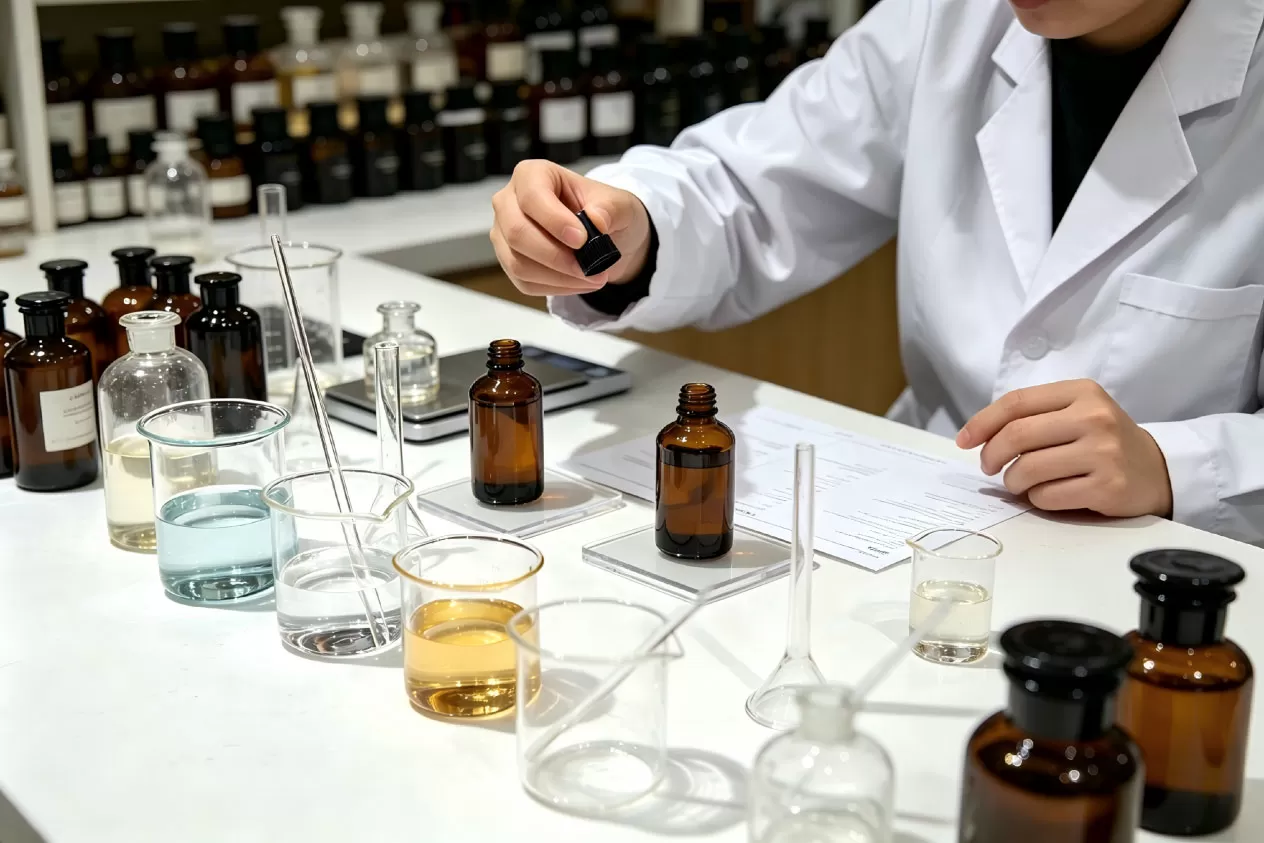
Every commercial fragrance relies on a complex balance of top, heart, and base notes. The development phase begins in the laboratory, where perfumers combine natural extracts with synthetic aroma molecules to construct a balanced olfactory profile. Synthetics offer stability and reproducibility, while natural oils contribute depth and complexity. Understanding this balance is necessary for creating long-lasting, sophisticated scents.
The formulation process involves several key parameters:
Aromatic Concentration: Determining the correct oil loading for the desired product class, such as Eau de Cologne (2-5%), Eau de Toilette (5-15%), or Eau de Parfum (15-20%).
Solvent Selection: Utilizing high-purity, denatured ethanol (usually SD Alcohol 40-B) that is free from off-odors, which ensures that the carrier fluid does not interfere with the fragrance notes.
Fixative Integration: Incorporating low-volatility compounds that slow down the evaporation rate of lighter top notes, extending the wearability of the perfume on the skin.
After the initial blending, the mixture enters the maceration phase. This step is indispensable for scent development. During maceration, the blended fragrance oil and alcohol solution is stored in stainless steel tanks at controlled temperatures for a period ranging from three to six weeks. This storage allows the chemical constituents to esterify and integrate fully. Skipping or shortening this step results in a harsh, alcohol-heavy opening note and poor overall performance.
Quality Control and International Compliance Standards
Safety and regulatory compliance form the foundation of successful global distribution. To export fragrances legally, a perfume supplier China must align its production processes with international standards. Chief among these are the guidelines established by the International Fragrance Association (IFRA). IFRA sets safety limits for specific chemical constituents to prevent dermal irritation and sensitization.
The table below outlines the necessary documentation required for global customs clearance and product registration:
| Document Type | Primary Function | Target Regions |
|---|---|---|
| Safety Data Sheet (SDS) | Details chemical composition, physical hazards, and emergency handling protocols. | Global / Universal |
| Certificate of Analysis (COA) | Verifies that the specific batch meets chemical and physical specifications (density, refractive index). | Global / Quality Assurance |
| IFRA Certificate | Confirms that the fragrance oil concentration complies with safety standards for skin contact. | Europe, North America, Oceania |
| Cosmetic Product Safety Report (CPSR) | Comprehensive safety assessment conducted by a certified toxicologist. | European Union (EU Regulation 1223/2009) |
Beyond documentation, factory-level quality control requires advanced testing equipment. Gas Chromatography-Mass Spectrometry (GC-MS) analysis is performed to verify the chemical fingerprint of each ingredient batch. This analysis ensures the absence of prohibited phthalates, heavy metals, or adulterated synthetics, safeguarding the brand against product recalls or legal challenges in foreign markets.
Glassware, Pumps, and Packaging Component Performance
The visual appeal of a luxury fragrance must be supported by physical durability and precise mechanical function. The selection of the glass flacon, pump atomizer, and collar must be evaluated alongside the liquid formulation. Alcohol-based perfumes act as strong solvents, meaning that poor-quality packaging components can degrade, resulting in leaks, discoloration, or pump failures.
To avoid these issues, professional manufacturers execute comprehensive compatibility testing. This procedure involves placing the filled glass bottles in environmental chambers heated to 40°C to 50°C for several weeks. This accelerated aging test reveals whether the plastic dip tube, internal gaskets, or metal collar components react with the fragrance oil. Any swelling of the dip tube, degradation of the pump spring, or cloudiness in the liquid indicates a material incompatibility that must be resolved before mass production.
The physical design of the bottle neck is equally important. The crimping force applied during the sealing phase must be precisely calibrated. If the force is too low, evaporation occurs over time, reducing the volume of the product on store shelves. If the force is too high, the glass neck can fracture, creating micro-cracks that lead to eventual failure. A reliable manufacturer uses automated crimping machinery equipped with sensors to monitor torque and pressure constantly during assembly.
Establishing an Efficient Production Workflow
Scale-up from laboratory samples to industrial-scale manufacturing requires structured workflow management. When partnering with Kourtisanes, the process follows a logical sequence designed to minimize errors and manage costs. This workflow includes detailed steps that transition the formulation smoothly from concept to physical inventory.
The production timeline typically unfolds across the following phases:
Scent Selection and Modification: The client evaluates initial scent directions. The perfumery team adjusts the aromatic compounds to achieve the desired olfactory profile and cost parameters.
Packaging Compatibility Analysis: Sourced glass bottles, pump mechanisms, and collars undergo physical stability testing with the finalized fragrance liquid.
Bulk Blending and Maceration: The fragrance concentrate is mixed with high-purity denatured alcohol and water, then left to age in temperature-regulated stainless steel tanks.
Chill Filtration: The aged mixture is cooled to temperatures below 5°C and passed through fine filters to remove any precipitated waxes or insoluble compounds, ensuring absolute clarity.
Filling, Crimping, and Packaging: Automated machinery fills the flacons, secures the atomizers, and packages the bottles into their primary boxes, followed by protective cellophaning.
By strictly adhering to this sequence, production risks are identified and corrected prior to high-volume manufacturing, saving significant capital and protecting the launch schedule.
Key Criteria for Selecting Your Manufacturing Partner
Selecting a suitable perfume supplier China requires evaluating several capabilities beyond basic pricing. Total cost of ownership includes the direct cost of goods, shipping expenses, regulatory compliance support, and the cost of potential defects. A partner with lower unit pricing but higher defect rates can ultimately cost a brand more than a supplier with stringent, automated quality control systems.
Minimum Order Quantities (MOQs) also represent a crucial variable. While massive automated lines are highly cost-efficient, they often require MOQs of 10,000 to 20,000 units per SKU. For emerging niche brands, finding a manufacturer that offers flexible production lines capable of executing smaller runs (e.g., 3,000 units) allows for testing market demand without excessive inventory overhead. Kourtisanes accommodates these varying market needs by offering scalable production capacities that support brands through different stages of growth.
Communication transparency is another vital asset. Fragrance development is an iterative process requiring clear dialogue regarding raw material sourcing, safety data, and production updates. A supplier that provides clear documentation, rapid physical sampling, and open updates regarding supply chain timelines reduces project risk and ensures a more predictable path to market.
Frequently Asked Questions
Q1: How does a perfume supplier China ensure that the fragrance does not discolor over time?
A1: Discoloration is usually caused by UV light exposure or oxidation of specific raw materials, such as vanillin or natural jasmine extracts. Manufacturers prevent this by incorporating UV filters (like Benzophenone-2 or Tinogard) into the formulation and using amber or opaque glass packaging. They also conduct accelerated sunlight exposure testing to verify the long-term color stability of the liquid.
Q2: What is the typical minimum order quantity (MOQ) for custom perfume manufacturing?
A2: MOQs vary depending on the complexity of the packaging and bottle design. For standard bottles with custom printing, the MOQ typically ranges between 3,000 and 5,000 units. If a brand requires custom-molded glass bottles, the MOQs generally start at 10,000 units to justify the engineering and tooling costs of the glass molds.
Q3: How are shipping hazards managed for alcohol-based liquid fragrances?
A3: Because perfumes contain high percentages of denatured ethanol, they are classified as Class 3 Flammable Liquids (UN 1266) under international shipping regulations. A professional supplier manages this by utilizing certified dangerous goods packaging, securing proper export licenses, and coordinating with specialized logistics providers experienced in handling maritime and air-freight hazardous materials.
Q4: Can a manufacturer reformulate an existing scent to make it IFRA-compliant?
A4: Yes, chemical analysis via GC-MS can identify the exact components of an existing scent. Perfumers then swap restricted or banned raw materials with synthetic or safe natural alternatives that mimic the original olfactory profile while adhering strictly to current IFRA standards and concentration limits.
Q5: What is chill filtration, and why is it necessary in the production process?
A5: Chill filtration involves cooling the aged perfume solution to temperatures near 0°C to 4°C. This cold treatment forces natural waxes, lipids, and other poorly soluble compounds to precipitate out of the liquid. The mixture is then passed through micro-filters, ensuring the perfume remains completely transparent and does not turn cloudy when exposed to cold temperatures during retail shipping or storage.
Initiate Your Fragrance Development Project
Developing a successful fragrance product requires a careful balance of chemical precision, regulatory compliance, and reliable manufacturing. Partnering with an experienced perfume supplier China like Kourtisanes provides your brand with the technical expertise, sourcing networks, and production infrastructure needed to deliver high-quality, international-grade perfumes.
To discuss your custom formulation requirements, packaging specifications, or to request initial physical samples, contact our B2B development team today. We invite you to submit a detailed inquiry outlining your project goals, target market, and projected volume requirements so that we can prepare a structured commercial proposal tailored to your brand’s needs.