
Oud: The Liquid Gold of Perfumery
What Is Oud?
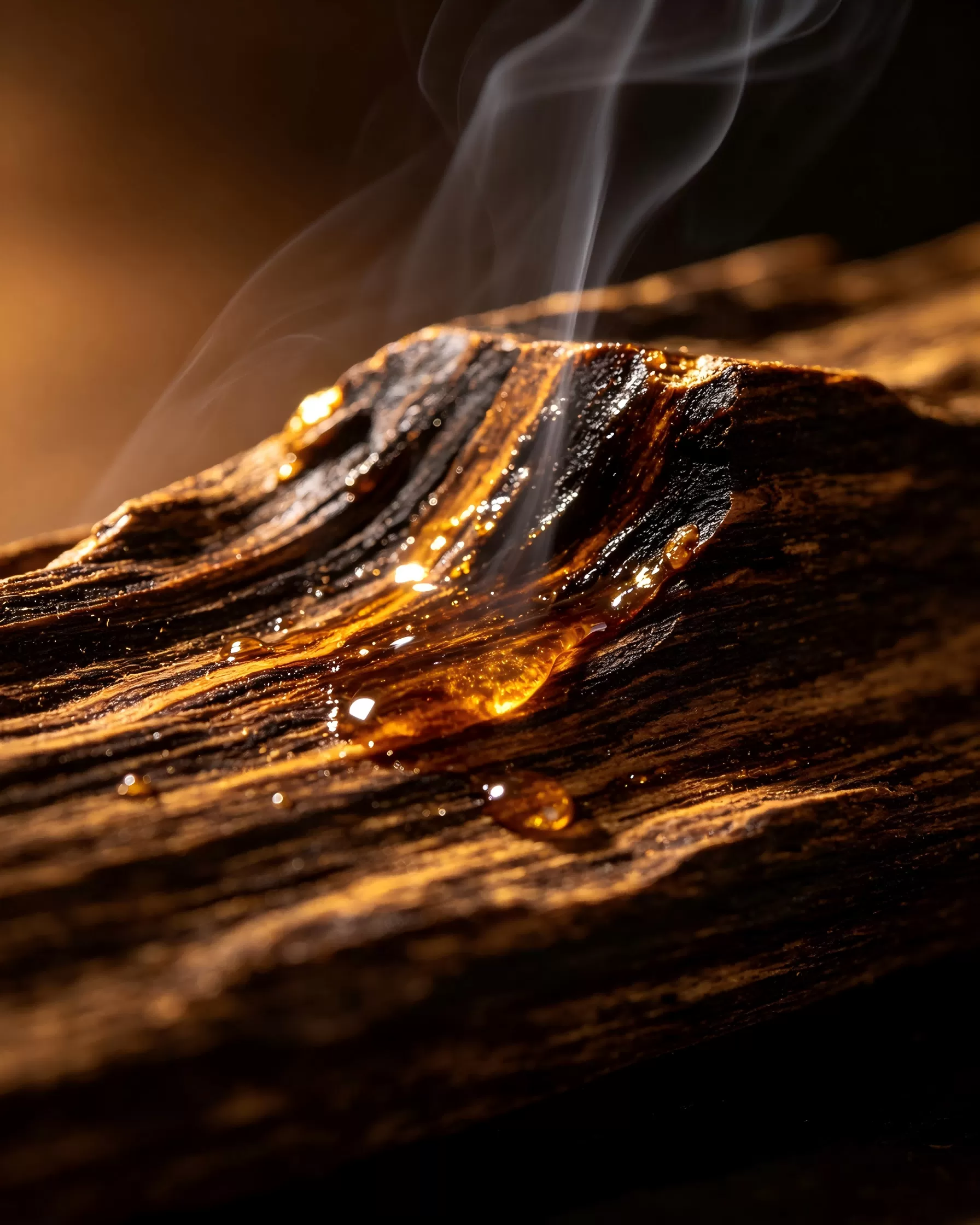
Oud is the aromatic resinous heartwood produced by trees of the genus Aquilaria, evergreens native to the rainforests of Southeast Asia, Bangladesh, Indonesia, Thailand, India, and parts of North India. However, a healthy Aquilaria tree does not produce oud. The transformation occurs only when the tree becomes infected by a specific type of mold or fungus—typically following physical damage from weather, insects, or other environmental forces.
In response to this invasion, the tree mounts an immune defense, producing a dark, fragrant resin that slowly permeates the heartwood. Over time—sometimes years or even decades—this resin-saturated wood becomes agarwood, the precious raw material from which oud oil is extracted. This natural phenomenon is exceptionally rare: only about one Aquilaria tree in a thousand develops this aromatic resin.
The word oud itself comes from the Arabic language, where it literally means “wood”. In Sanskrit, it was known as gahuru or agahuru, described as prâna— “life” or “spirit of life”.
The Scent Profile: A Symphony of Complexity
Oud is widely regarded as one of the most complex and polarizing ingredients in perfumery. Its scent is not singular but multifaceted, evolving dramatically over time on the skin.
Initial impression: Oud oil unfolds with an initial medicinal smokiness, reminiscent of antique wooden apothecary cabinets. Some describe its raw, unadulterated form as having animalic, almost barnyard-like qualities—even pungent cheese or goat-like notes that can challenge the uninitiated nose.
Heart notes: As it develops, oud reveals a rich tapestry of leathery, smoky, and balsamic facets, softened by honeyed sweetness. The finest oud oils can contain up to 150 different naturally occurring aromatic compounds, creating a scent that feels less linear than alive.
Dry-down: The finish lasts for days, leaving a haunting trail of incense-like warmth with subtle floral nuances that emerge like forgotten memories. Authentic oud carries an almost holographic complexity, shifting between leather, wood, and fruit facets with each sniff.
Extraction: The Art of Distilling Liquid Gold
The journey from agarwood chips to oud oil is a meticulous, labor-intensive process.
Selection and preparation: Artisan distillers begin by selecting agarwood chips, carefully removing unusable wood and retaining only the resin-rich portions. This sorting process often takes hours and requires expert knowledge.
Soaking: The selected chips are soaked in water to prepare them for distillation.
Distillation: The oil is extracted through steam distillation, hydro-distillation, or hydro-steam distillation. The chips are transferred to distillation apparatus where steam carries the volatile aromatic compounds from the wood. The resulting oil is dark in coloration and possesses an exceptionally potent aroma.
Rarity and cost: The combination of rare natural occurrence, labor-intensive extraction, and soaring global demand makes oud one of the most expensive raw materials in perfumery. Raw agarwood can sell for $5,000 per pound, and a 3-gram bottle of pure oud essential oil typically costs $300 or more. The annual global oud market is estimated at $6 billion.
Oud in Perfumery: The Architect of Fragrance
Within a fragrance composition, oud serves as more than just a note—it acts as an invisible architecture. It structures, deepens, and gives a fragrance its backbone.
A powerful base note: Oud is predominantly used as a base note, prized for its exceptional longevity—typically lasting eight to fourteen hours on the skin. Its rich, earthy, animalic, and smoky accords provide a sensual dry-down that anchors lighter ingredients.
The bass note of the symphony: Oud acts like a bass note in a symphony, grounding lighter ingredients such as rose, jasmine, or citrus with a dark, resinous foundation. It makes perfumes feel fuller, more complex, and more resonant.
.webp?t=1789033414513 "沉香图片制作需求 (1)")
Iconic fragrances featuring oud:
Tom Ford Oud Wood (2007) : A modern classic that blends oud with cardamom and vanilla, softening oud’s animalic edges while showcasing its woody depth.
Yves Saint Laurent M7 (2002) : One of the first Western fragrances to feature oud prominently, using it to create a medicinal, almost antiseptic woody character.
Montale Black Aoud (2006) : An intense composition pairing oud with rose in a classic Middle Eastern style.
Dior Oud Ispahan (2012) : Emphasizes oud’s smoky, resinous qualities by pairing it with patchouli and sandalwood.
Used excessively, oud dominates a composition. Handled with precision, it magnifies and elevates every other ingredient.
Conclusion
Oud is far more than a fragrance ingredient—it is a living piece of history, a cultural touchstone, and a testament to nature’s capacity for transformation. From the wounded heart of an Aquilaria tree emerges a scent that has shaped spiritual rituals, bridged civilizations, and redefined modern luxury perfumery. Its complexity challenges the nose, its rarity commands respect, and its beauty endures.
As Mona Kattan, founder of Kayali Fragrances, observes: “Oud has an extraordinary ability to tell a story; it’s rich, rare, and deeply evocative. That sense of authenticity is what makes it so compelling”. At Kourtisanes Fragrance, we honor this extraordinary ingredient by sourcing with integrity and crafting compositions that allow oud’s timeless voice to be heard.