
Custom Replica Fragrance Oil: Industrial Formulation & Scaling Guide
The global fine fragrance and ambient scenting markets increasingly demand exact olfactory reconstructions capable of meeting rigorous commercial performance benchmarks. In contract manufacturing and private label cosmetics, utilizing a high-grade replica fragrance oil bridges the gap between historical formulation aesthetics and modern consumer product requirements. Delivering exactness in scent reproduction requires far more than rudimentary sensory matching; it hinges on advanced analytical chemistry, comprehensive raw material traceability, and an intimate understanding of physical chemistry. For cosmetic chemists, corporate procurement officers, and fragrance product managers, integrating precision-engineered fragrance compounds demands a methodical evaluation of volatility curves, solvent dynamics, and compliance architectures.
Analytical Deconstruction and Olfactive Architecture
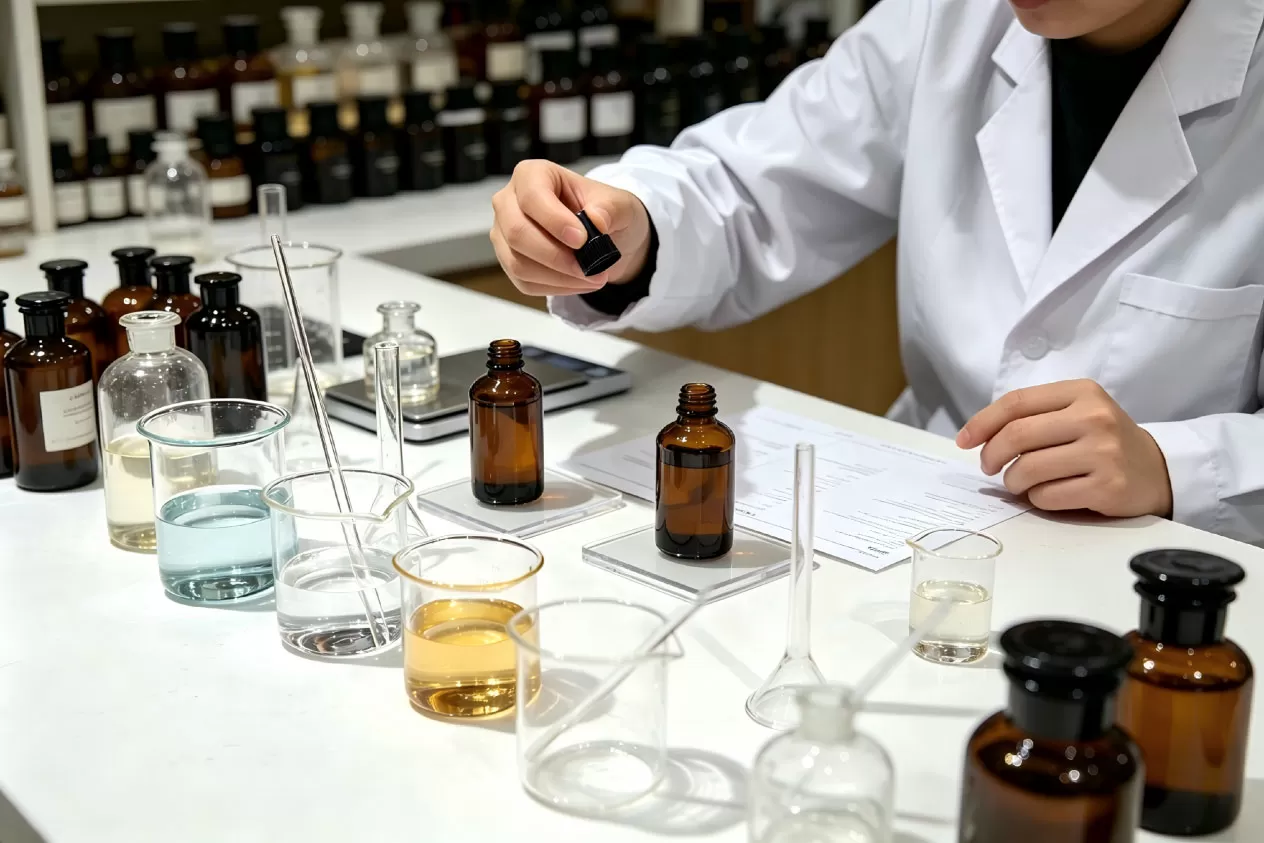
Deconstructing an established aroma profile into an industrially viable formula begins with gas chromatography-mass spectrometry (GC-MS). This analytical platform separates complex volatile mixtures into individual chemical constituents, identifying aroma chemicals by comparing mass spectral fragmentation patterns against extensive spectral libraries. Capillary columns coated with varying stationary phases—such as non-polar polydimethylsiloxane or polar polyethylene glycol—ensure precise resolution of isomers, trace sesquiterpenes, and complex synthetic musks.
GC-MS alone cannot capture the complete sensory identity of a living botanical or a maturing fine fragrance. Headspace solid-phase microextraction (SPME) complements traditional chromatographic analysis by sampling the volatile organic compounds (VOCs) present in the air surrounding a formulation without solvent extraction. This dual approach reveals the true evaporation sequence of the olfactive pyramid, detailing how low-molecular-weight top notes (such as terpenes, aliphatic aldehydes, and light esters) release during initial atomization, transitioning smoothly into the heart notes (macrocyclic lactones, damascones, and ionones) before settling into dense fixative bases (such as Ambroxan, polycyclic musks, and woody hydrogenated quinolines).
Reconstruction perfumers face the technical task of translating raw spectral readouts into a coherent formula. Natural essential oils contain hundreds of micro-components that present subtle chiral variations. Sourcing chiral synthetics or fractionated natural isolates allows the formulation chemist to eliminate undesirable olfactory artifacts while preserving the nuanced depth of the original scent silhouette. This molecular reconstitution underpins every robust replica fragrance oil developed for enterprise-level scaling.
Carrier Chemistry and Solvation Dynamics
The stability and olfactory projection of a fragrance concentrate depend heavily on its secondary diluents and carriers. Unadulterated fragrance oils contain pure aromatic chemicals, crystalline absolutes, and heavy resins that require stabilization within non-reactive solvent matrices. Selecting an improper carrier can lead to cloudiness, phase separation, or premature oxidation of aldehyde-heavy compounds.
Dipropylene Glycol (DPG): The benchmark hydrophilic-lipophilic balanced solvent for fine perfumery and candle applications. DPG exhibits minimal odor interference, high solvency for crystalline musks, and ideal vapor pressure suppression to extend longevity.
Isopropyl Myristate (IPM): A light ester widely used in cosmetic formulations and anhydrous personal care. IPM reduces tackiness, enhances skin absorption, and accelerates top-note volatilization without breaking down sensitive esters.
Triethyl Citrate (TEC): A natural-origin, biodegradable carrier favored in eco-certified formulations. TEC provides exceptional solubilizing capacity for viscous natural resins while doubling as a mild fixative agent.
Medium-Chain Triglycerides (MCT): Preferred for roll-on perfume oils and clean-beauty formulations. MCT provides oxidation-resistant lipophilic stability, although its lower polarity can restrict the solubility of highly polar synthetic molecules.
Evaluating the kinematic viscosity and flash points of these solvent blends is essential during the procurement phase. Automated bottling lines require uniform viscosity across varying ambient operating temperatures to prevent metering discrepancies. Flash point data determines shipping classifications under international maritime (IMDG) and air transport (IATA) hazardous material guidelines, directly affecting transport logistics and warehousing overhead.
Procurement Standards and Batch-to-Batch Quality Metrics
Procuring raw materials for commercial personal care and household applications demands stringent consistency. A subtle variance in the chemical synthesis of an aroma molecule can noticeably shift the sensory balance across an entire production run. Engineering and procurement teams must enforce strict analytical specifications before releasing raw fragrance shipments to the compounding floor.
At the synthesis and blending stages, Kourtisanes integrates comprehensive quality assurance protocols to govern physical and chemical properties across all production batches. Establishing baseline parameters prevents production failures down the supply line.
Specific Gravity Determination: Measured via oscillating U-tube digital densitometers at 20°C or 25°C. Any drift outside the standard tolerance range (typically ±0.005 g/cm³) indicates solvent evaporation, improper carrier dilution, or inaccurate compounding proportions.
Refractive Index (RI): Assessed using automated refractometers to evaluate light propagation through the liquid matrix (standard tolerance typically ±0.003 at 20°C). RI serves as an immediate, non-destructive check on mixture homogenization.
Color and Clarity Evaluation: Monitored via the Gardner or platinum-cobalt (Pt-Co) color scales. Color variations often signal raw material oxidation, presence of iron contaminants, or light-induced degradation of phenolic components such as vanillin or eugenol.
Acid and Peroxide Values: Critical chemical markers indicating initial stages of rancidity or auto-oxidation of aldehydes into carboxylic acids, which can suppress fragrance projection and degrade product pH balance.
Navigating Global Regulatory Frameworks and Consumer Safety
Industrial deployment of scent oils must balance aesthetic performance with evolving international safety directives. Scent replication projects cannot merely copy an older formulation; they must modernize it to comply with modern safety standards. Raw materials that were widely accepted decades ago—such as unrefined oakmoss, specific nitromusks, and high-concentration lilial—are either strictly capped or outright prohibited under modern consumer safety regimes.
Technical teams must adhere to the latest amendments of the International Fragrance Association (IFRA) Standards. The 51st Amendment systematically regulates maximum allowable concentrations of specific chemical categories across distinct product applications, ranging from lip balms (Category 1) to fine fragrances (Category 4) and continuous-air ambient devices (Category 12). Scent designers must rebuild classic accords utilizing structurally stable molecules that comply with quantitative risk assessment (QRA2) benchmarks.
Compliance with Regulation (EC) No 1223/2009 in the European Union introduces additional layers of scrutiny. The expansion of the European list of declarable fragrance allergens requires exact chemical reporting for compounds exceeding 0.001% in leave-on products and 0.01% in rinse-off applications. Formulators must maintain transparent Safety Data Sheets (SDS) formatted under the Globally Harmonized System (GHS), backed by comprehensive Toxicological Risk Assessments (TRA) and Certificates of Analysis (CoA) to ensure smooth market entry.
Industrial Scaling: Blending, Maceration, and Product Integration
Moving a scent formulation from an analytical pilot bench to full-scale batch manufacturing introduces complex physical kinetics. Scale-up operations must account for the thermodynamic behavior of raw materials, shear sensitivity during agitation, and maturation processes that define the finished profile.
During the industrial blending of a replica fragrance oil, compounding sequence determines formula stability. Highly crystalline ingredients—such as coumarin, maltol, or cedarwood-derived cedrol—require pre-dissolution in designated warm carrier solvents (typically 35°C to 45°C) before introduction into the main blending vessel. Applying excessive heat must be avoided, as it degrades thermosensitive monoterpenes and initiates cross-linking reactions among delicate unsaturated esters.
Maceration and maturation play vital chemical roles in the stabilization of the final compound. When the concentrated oil is blended into an ethanol-water matrix for fine perfumery, chemical equilibria must stabilize. Aldehydes and alcohols react slowly to form hemiacetals and acetals, softening harsh olfactory edges and standardizing the rate of evaporation. In commercial scale production, pressurized stainless steel (SS316L) tanks with controlled inert nitrogen blanketing shield the oil from ambient oxygen, preventing free-radical formation during the maturation period.
Filtration procedures represent the final physical purification stage. Chilling the concentrated bulk solution to temperatures between 0°C and 4°C precipitates heavy waxes, low-solubility terpene fractions, and traces of insoluble plant lipids. Passing the chilled liquid through progressively finer sub-micron depth filters (down to 0.45 microns) yields an optically clear product that will not cloud or separate under cold distribution and storage conditions.
Preventing Chemical Degradation in Finished Applications
Fragrance oils interact directly with the vehicle bases into which they are integrated. Whether compounding an emulsion, a surfactant-based body wash, a wax matrix, or an alcoholic spray, chemical incompatibilities can degrade the fragrance performance or destabilize the delivery vehicle.
Vanillin and ethyl vanillin present notorious formulation challenges due to their tendency to form Schiff bases when exposed to primary amines, causing dark brown or purplish discoloration in soaps, lotions, and creams. Cosmetic scientists manage this by pairing stabilizing additives with specialized non-discoloring vanilla accords. These modified accords replicate the warm, gourmand olfactory profile of natural vanilla without relying on free phenolic aldehydes.
Photo-oxidation and thermal breakdown also threaten product integrity. Exposure to ultraviolet (UV) radiation triggers free-radical chain reactions that break down unsaturated carbon chains, leading to off-odors and visual fading. Integrating complementary antioxidant packages—such as butylated hydroxytoluene (BHT) alternatives, tocopherol (Vitamin E), or synthetic benzotriazolyl compounds—preserves the original aromatic architecture. In technical collaboration projects, Kourtisanes formulates tailored antioxidant and UV-absorber systems directly into the oil concentrate, ensuring chemical stability across the entire retail shelf life.
Application-Specific Formulation Adjustments
A single scent concentrate cannot perform identically across diverse finished product formats. The base matrix directly dictates how volatile aromatic molecules partition between the product, the air, and the substrate (skin, hair, or textile fibers).
Alcoholic Fine Fragrance: Demands exceptional solubility in denatured ethyl alcohol (typically SDA 40B, 96% purity) and deionized water. The challenge lies in managing the flash-off phase so that top notes are immediately discernible without harsh solvent interference.
Soy and Paraffin Wax Candles: Requires elevated flash points (ideally above 75°C to 80°C) to prevent combustibility issues during pouring and burning. The oil formulation must offer high thermal stability, preventing "clobbered" or scorched off-notes when exposed to a continuous flame, while maximizing the cold and hot scent throws.
Surfactant Cleansers and Shampoos: Fragrance compounds must not disrupt micellar networks. Certain hydrophobic terpenes can decrease the viscosity of surfactant solutions, transforming rich gels into runny liquids, while other polar molecules can cause cloudiness. Custom emulsification matching balances clarity with high fragrance load capacity.
Cold-Process Soap: Fragrance oils must withstand highly alkaline environments (pH > 10). Unstable esters quickly undergo saponification, neutralizing their aroma. Additionally, certain spice derivatives (like eugenol) accelerate the chemical trace, leaving batch operators insufficient time to pour the soap mixture into production molds.
Frequently Asked Questions
Q1: How does a reconstructed fragrance oil differ from an unrefined
reverse-engineered blend?
A1: An unrefined reverse-engineered blend
relies strictly on basic GC-MS output, often missing minor isomeric components,
micro-traces, and the balancing effects of fixative solvents. A professional
industrial reconstruction involves expert evaluation by fine fragrance chemists,
correcting for thermal breakdown during analysis, substituting restricted raw
materials with compliant molecules, and adjusting volatile release curves for
scalable manufacturing.
Q2: What causes a finished product containing fragrance oil to turn
cloudy over time?
A2: Cloudiness usually stems from phase separation
or low solubility within the vehicle base. In aqueous or low-alcohol systems,
the oil's lipophilic components (such as heavy musks, fixed resins, or citrus
terpenes) can drop out of the micellar or alcoholic solution. This issue can be
resolved by adjusting the surfactant system, adding co-solvents such as
Dipropylene Glycol or Polysorbates, or chill-filtering the concentrate before
bottling.
Q3: How do the latest IFRA amendments affect legacy scent
reconstructions?
A3: IFRA amendments continuously refine the
concentration limits of specific aroma molecules based on dermal sensitization,
phototoxicity, and systemic safety data. When re-engineering a classic or legacy
scent profile, chemists must replace banned or restricted ingredients with safe,
modern synthetic molecules or purified fractions that mimic the target profile
without exceeding established concentration limits.
Q4: Why does a fragrance oil perform well in an alcoholic base but
fail in a candle?
A4: Performance across media depends on thermal
volatility and solubility parameters. In an alcoholic fine fragrance, alcohol
acts as a rapid carrier that evaporates quickly, leaving the scent to bloom on
warm skin. In a candle, the fragrance oil must completely dissolve within
non-polar wax crystals, survive the intense heat of the molten pool without
decomposing, and volatilize smoothly off the capillary wick. Formulations for
candles require higher flash points and heavy, heat-tolerant fixatives.
Q5: What are the standard storage and shelf-life parameters for bulk
fragrance oils?
A5: Commercial fragrance concentrates typically
maintain stability for 12 to 24 months when stored correctly. Optimal storage
requires airtight fluorinated HDPE containers or epoxy-lined steel drums stored
between 15°C and 21°C, protected from light, moisture, and elevated
temperatures. Maintaining a continuous inert nitrogen headspace blanket after
opening prevents headspace oxygen from initiating oxidative breakdown.
Industrial Sourcing and Custom Development
Developing high-precision scent compounds requires close technical alignment between raw material formulators, analytical chemists, and brand procurement teams. From initial molecular chromatography to full regulatory certification, deploying a reliable replica fragrance oil ensures commercial consistency across high-volume production lines. Kourtisanes provides specialized technical consultation, bespoke accord formulation, and comprehensive analytical documentation for commercial brands, hospitality scenting programs, and contract packaging enterprises worldwide.
To initiate a technical inquiry, request comprehensive Safety Data Sheets (SDS), or consult on bespoke formulation requirements for upcoming product runs, connect directly with our application engineering team at info@kdsfj.com.
.webp "Custom Replica Fragrance Oil: Industrial Formulation & Scaling Guide")